
7. EXHIBITIONs in paris – 1938 TO 1950S
One of the primary ways for Chinese artists in Paris to gain recognition was by participating in prestigious exhibitions. Yan Dehui showcased his works in numerous significant venues at the Grand Palais, as early as 1938 at the Salon des Artistes Français. He chose to introduce traditional Chinese sculpture to the Parisian public with his Blind Man’s Bluff, a set of carved boxwood statuettes closely modeled on that of his master, Zhu Zichang.
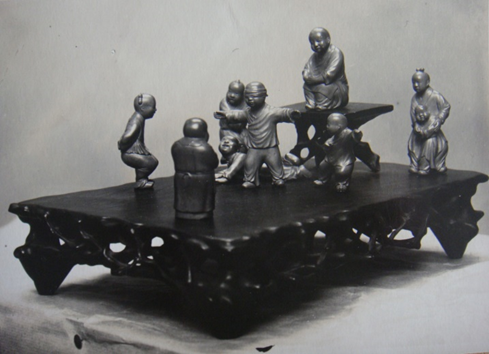
Blind Man’s Bluff, boxwood
His involvement continued through the 1940s and 1950s with exhibitions at the Société Nationale des Beaux-Arts (SNBA), the Cernuschi Museum, the ENSBA – École Nationale Supérieure des Beaux-Arts, the Raymond Duncan Gallery and the Salon des Indépendants, of which he became a member in 1949.
While he mainly presented academic sculptures – nudes and portraits corresponding to the teaching of the ENSBA – he was also keen to introduce the French public to figures from Chinese culture or characters belonging to the Buddhist or Taoist pantheon.
The year 1946 marked an important moment for the members of the Association of Chinese Artists in France, who took part in two major exhibitions — the first at the Cernuschi Museum, and the second at the École nationale supérieure des Beaux-Arts, under the auspices of the Association.
Cernuschi Museum, June 1946
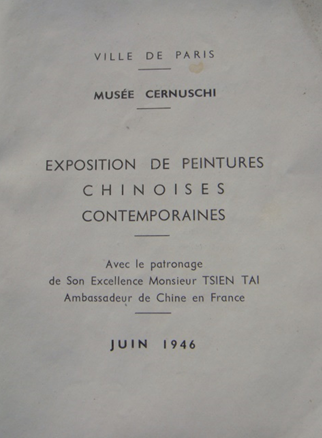
Exhibition catalogue
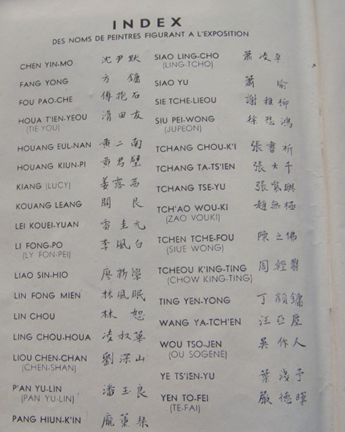
List of exhibitors – Sculpture section
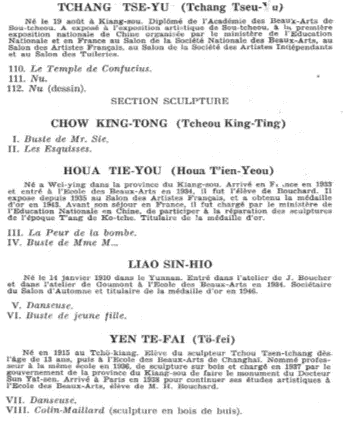
Yan’s “Gypsy” (La Gitane) almost 2 meters high, was presented under the name of “Dancer” in 1946, at the Cernuschi Museum and ENSBA. It was his major work that year. Almost 70 years later, Gypsy found a familiar place – she was acquired as a permanent collection of Cernuschi Museum in 2015.
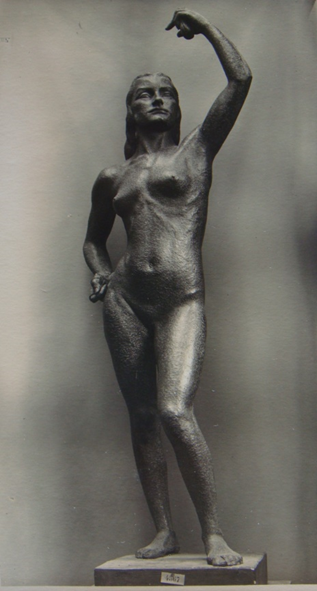
The Gypsy or Dancer, patinated plaster
ENSBA, October 1946
Between October 1 and 20, 1946, the Association of Chinese Artists in France organized an exhibition at ENSBA to commemorate the first anniversary of ” The Victory in the War of Resistance of the Chinese People against Japanese Aggression and the World Anti-Fascist War “, universally known as World War II. There, Yan showcased the Gypsy once again.
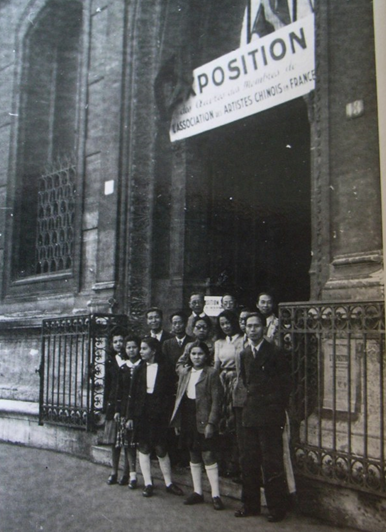
Exhibition of the Association of Chinese Artists in France at ENSBA, 1946
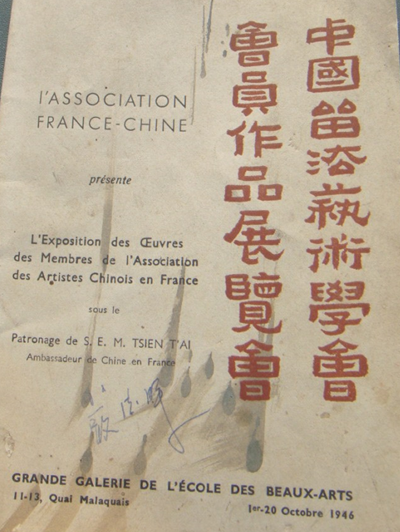
Exhibition catalogue, ENSBA 1946
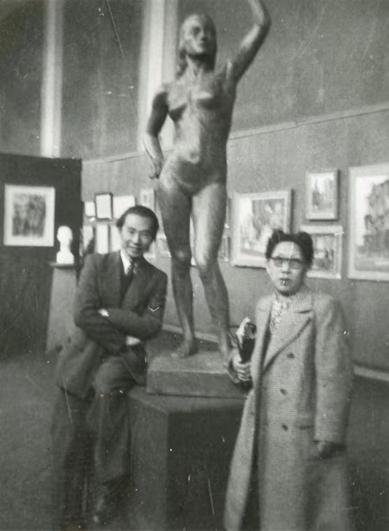
Pan Yuliang with Yan Dehui in front of the Gypsy
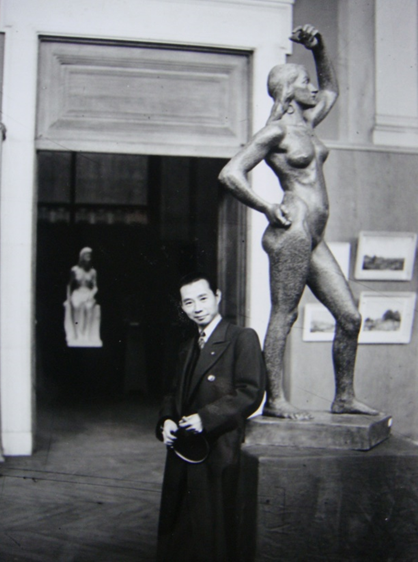
Yan Dehui in front of The Gypsy or Dancer, ENSBA 1946
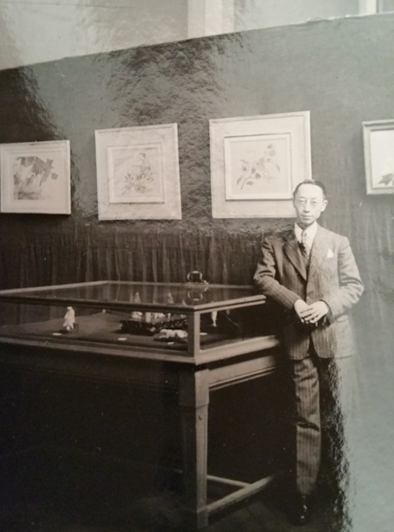
Boxwood statuettes by Yan Dehui and Zhou Lin in front of his paintings, ENSBA 1946
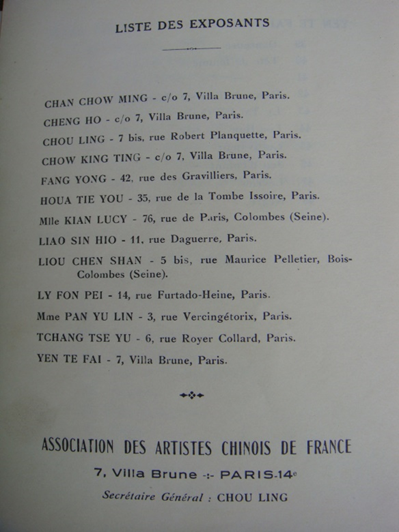
List of exhibitors, ENSBA 1946
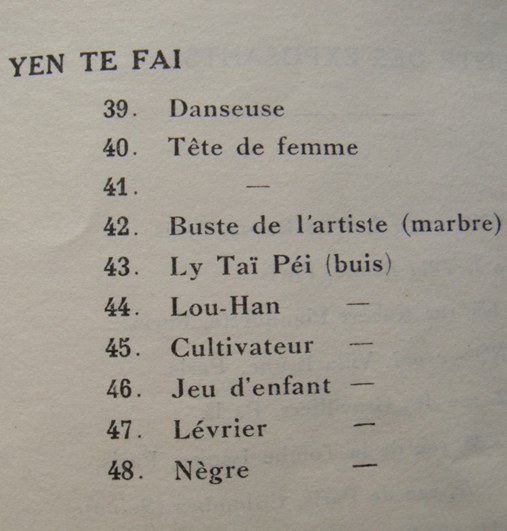
List of works by Yan Dehui, ENSBA 1946
Salon des Indépendants, 1948 to 1950
At the Indépendants, he chose to highlight traditional Chinese art by presenting Confucius in 1948 and Lin Daiyu Buries the Flower in 1949. In 1950, he exhibited the portrait bust of Louise Lenoir, his future wife.
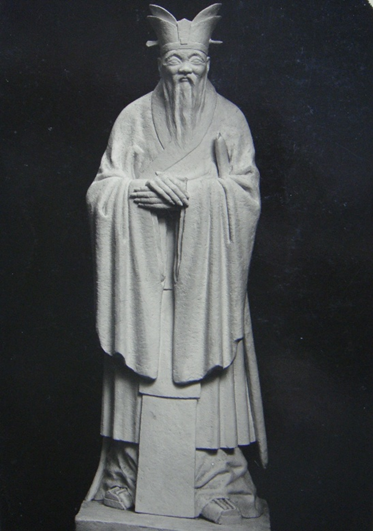
Confucius
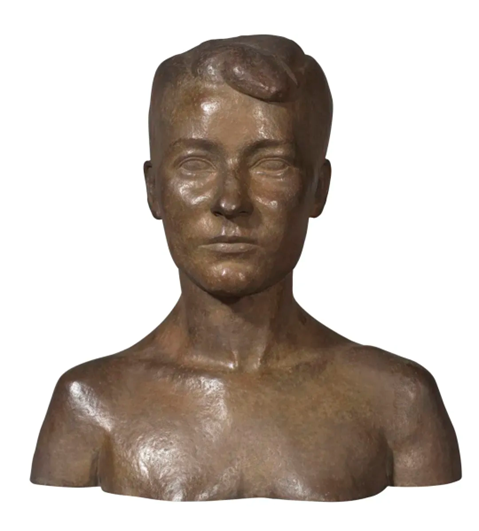
Louise Lenoir
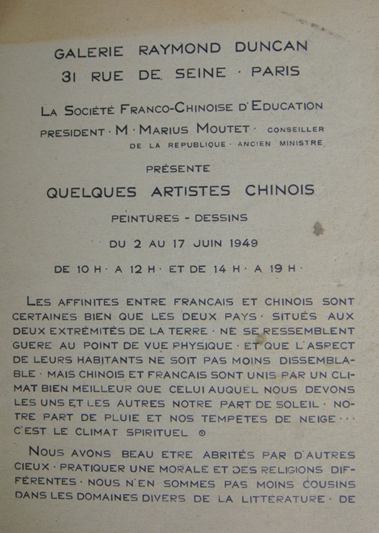
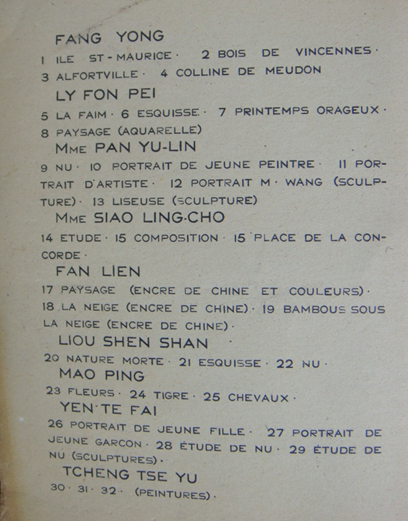
Galerie Raymond Duncan – 1949
In 1949, Raymond Duncan, brother of the dancer Isadora Duncan, exhibited works by several Chinese artists in his gallery. Yan presented two nude studies and two portraits on that occasion.
SNBA – Société Nationale des Beaux-Arts, 1940s – 1950s
From the 1920s to the 1950s, the SNBA was a major Salon for Chinese artists. It was mainly held at the Grand Palais.
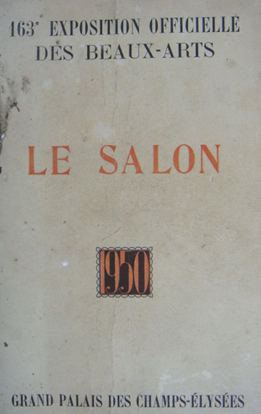
SNBA 1950 Salon Catalogue
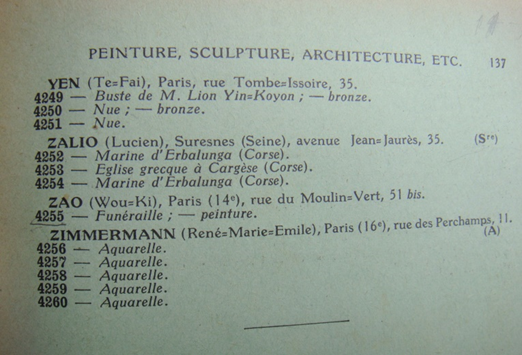
In 1949, Yan was elected an associate member of the Société Nationale des Beaux-Arts (SNBA). His participation in the Salon that year was distinguished by the award of two prizes: the Sandoz Prize and a sculpture prize offered by a generous patron. In 1950, he was elected a full member of the SNBA. In 1951, he became a member of the jury on the admissions committee and, in this capacity, took part in the installation of the works. In 1952, he was awarded the Kronberg Prize. He remains the only Chinese artist to have achieved such a trajectory within the SNBA.
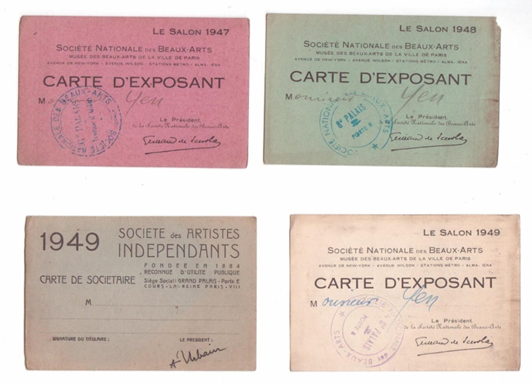
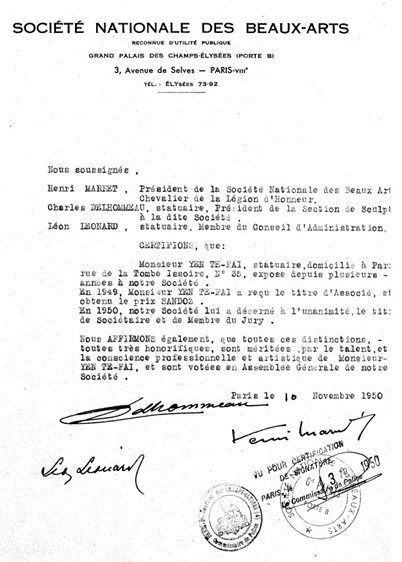
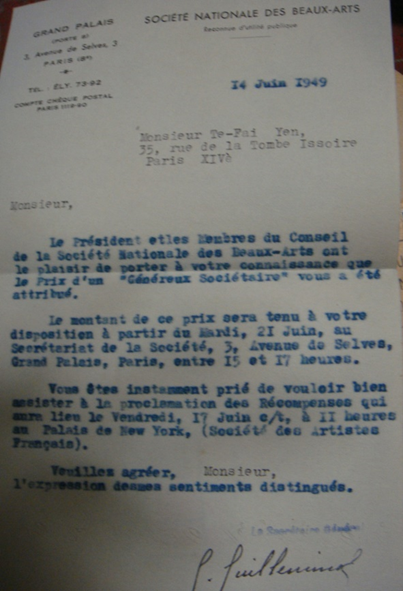
Sculpture Prize awarded by a generous member, 1949
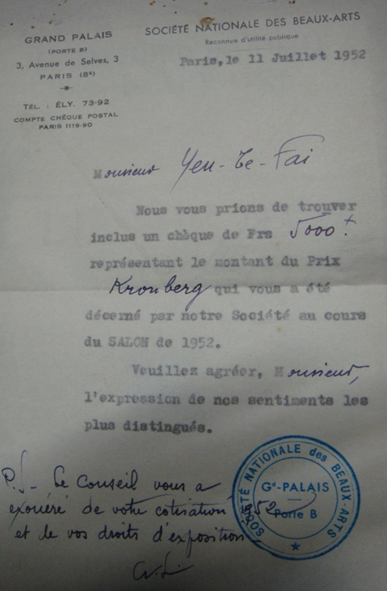
Kronberg Prize, 1952
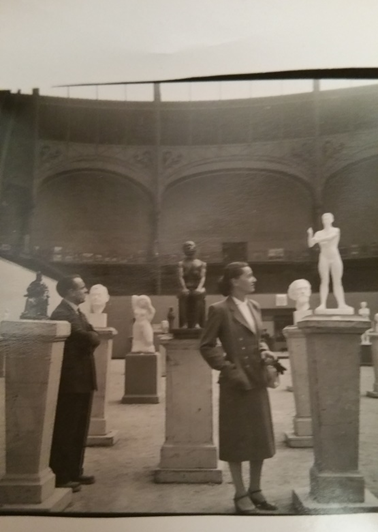
Five works by Yan Dehui (Guanyu and a male nude in the foreground, Josepha in the center and two male portrait busts in the background), SNBA Salon, Grand Palais 1952
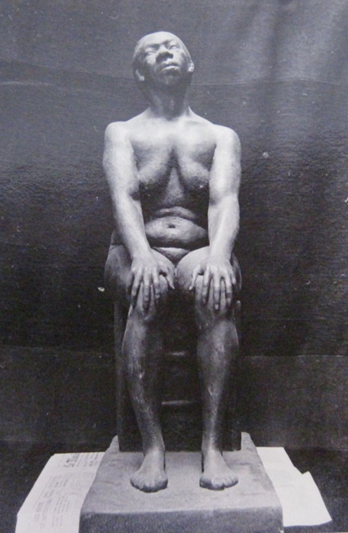
Josepha, patinated plaster
The photo of these five works displayed in the 1952 salon illustrates the variety of styles presented by Yan Dehui in a same exhibition. On the left, a representation from traditional Chinese iconography, the figure of Guanyu, a general from the time of the Three Kingdoms (220-280 AD), very popular in China and later deified, sometimes represented holding a book in his hands. On the right, a male nude executed according to the academic canons of the period, as are the two male portraits in the background.
The image of Josepha, in the middle, looks nowadays surprisingly modern. In 2019, an unprecedented exhibition in France was held at the Orsay Museum in Paris, “Le Modèle Noir, from Géricault to Matisse” (“The Black Model, from Géricault to Matisse“). The aim was to give visibility to the anonymous so-called colored people represented by artists during a period ranging from the 18th century to the interwar period. In relation to this new approach to artistic expression, Chinese artists also have their place, as evidenced by this sculpture, among several executed by Yan Dehui on the same subject, also treated by Hua Tianyou, Sanyu and Pan Yuliang.
It is to be noted that the name of Josepha appears in the list of ENSBA models, from 1929 to 1959, published in the catalog of the Orsay exhibit.